Blog
AC vs AC/DC vs Inverter Fan in Pakistan — Which One Should You Buy?

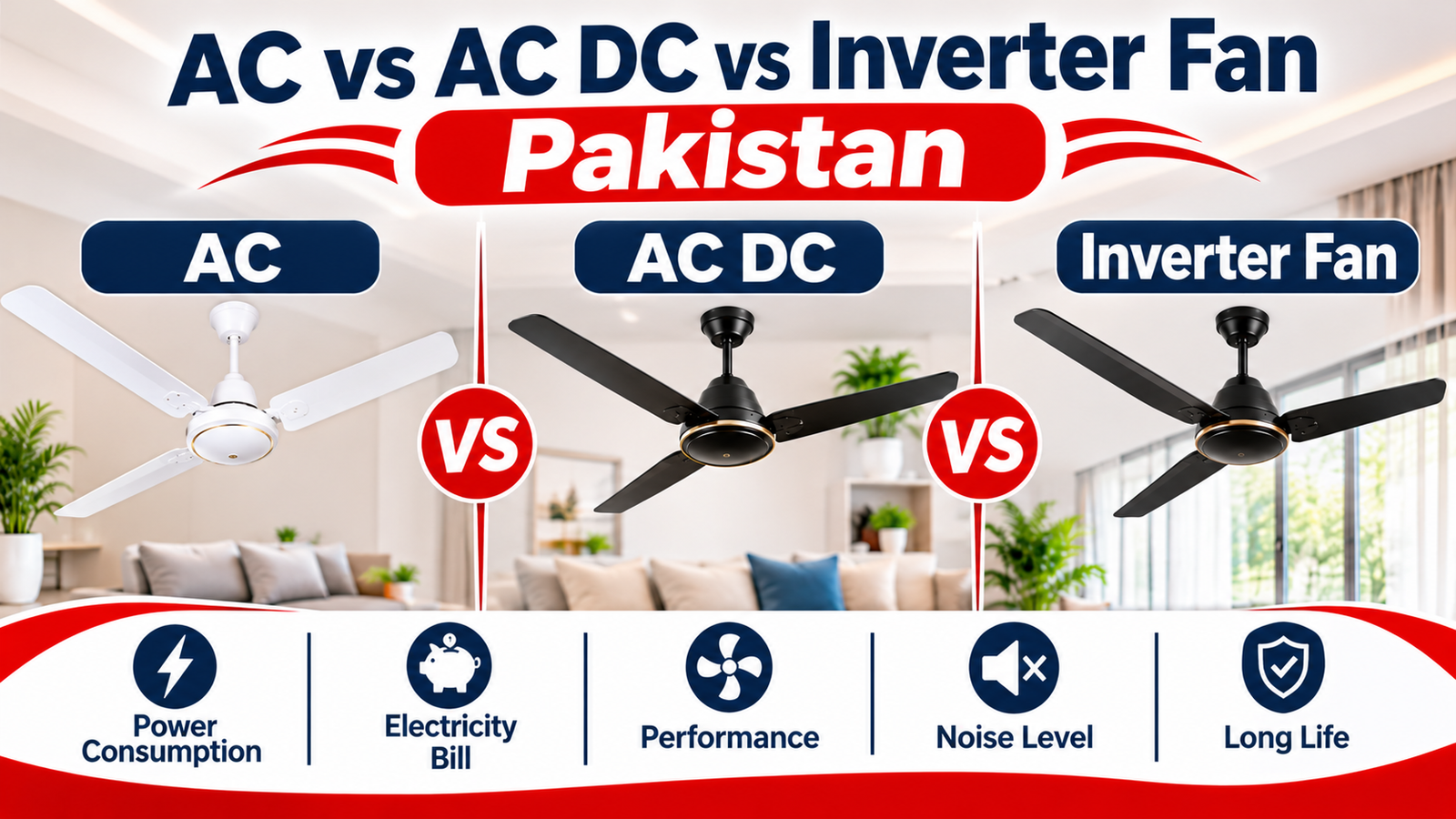
Shopping for a ceiling fan in Pakistan means facing three confusing labels: AC, AC/DC, and inverter. This guide explains AC vs AC DC vs inverter fan Pakistan in simple words: which suits load shedding, which cuts your bill, and which works best with solar or a UPS.
Also read: Top Ceiling Fans in Pakistan 2026 guide
What Is an AC Fan?
An AC fan is the conventional ceiling fan most Pakistani homes have used for decades. It runs directly on normal 220V AC mains from WAPDA, and typically draws 75 to 120 watts at full speed, the figure in Fusion Fans’ own buying guide.
AC fans are simple: no remote in most basic models, no electronic motor control, and no backup mode. When the electricity goes, the fan stops.
An AC fan suits a rarely used room or a home with stable electricity where the buyer wants the lowest purchase price.
What Is an AC/DC Fan?
An AC/DC fan can work on two power supplies: normal AC mains and a compatible DC supply, such as a battery or solar setup. “AC/DC” means power input, not motor type.
Fusion Fans’ AC/DC models use a BLDC motor. Their published specifications are 50 watts, 90–290V input, 360–380 RPM, 56-inch size, with a remote control. That wide voltage range matters in Pakistan, where voltage often fluctuates.
An AC/DC fan is the practical choice for load shedding: instead of stopping when WAPDA goes off, a compatible setup can keep it running from a DC source. Whether it does so in your home depends on your battery, wiring, and that model’s DC input — check the product page first.
What Is an Inverter / BLDC Fan?
An inverter fan, also called a BLDC fan, uses electronic control and a brushless DC (BLDC) motor to run more efficiently. “Inverter” describes the motor technology, not a separate power source.
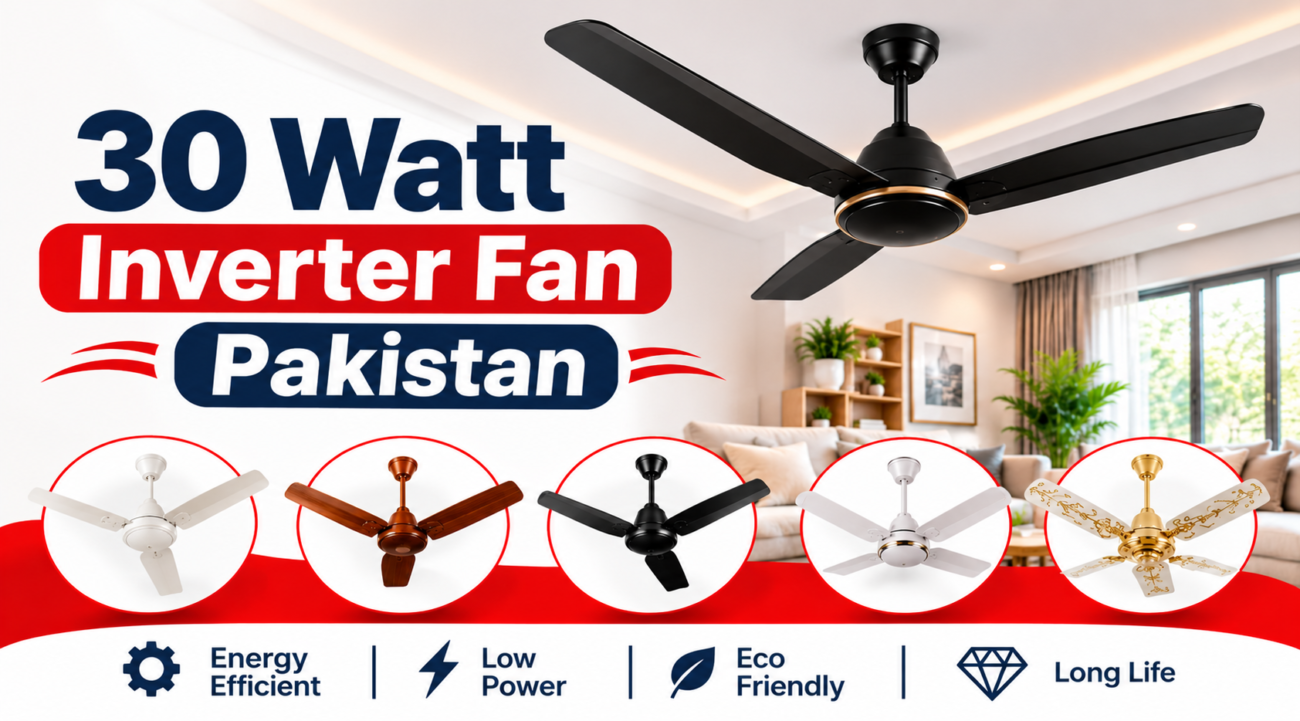
Fusion Fans’ Eco Smart range is its inverter / BLDC range. These fans run at 30 watts, against around 120 watts for a conventional fan in the site’s example. Fusion Fans claims energy savings of up to 70% compared with conventional fans.
The site’s example: a conventional 120W fan costs about Rs. 3,240 per month to run, while a 30W Eco Smart fan costs about Rs. 1,080 per month. Your saving will depend on your tariff and hours of use.
An inverter fan also runs more smoothly and quietly, and is designed to work with UPS and inverter systems. It does not run on a battery by itself; backup time depends on your battery and setup.
AC vs AC/DC vs Inverter Fan — Comparison Table
| Feature | Conventional AC fan | AC/DC fan | Inverter / BLDC fan (Eco Smart) |
|---|---|---|---|
| Power draw | Typically 75–120 watts | 50 watts (Fusion AC/DC models) | 30 watts (Fusion Eco Smart models) |
| Power input | AC mains only | AC mains + compatible DC supply | AC mains, with inverter / BLDC motor control |
| Backup | No — stops when power goes | Yes, with a compatible DC / battery setup | Yes, with a compatible UPS / inverter setup |
| Voltage range | Narrower; speed can drop | 90–290V (Fusion AC/DC models) | Stable, efficient running |
| Noise | Can be noisier as it ages | Quieter BLDC motor | Quieter BLDC motor |
| Purchase price | Lowest | Mid-range | Mid-range |
| Running cost | Highest | Lower than AC | Lowest of the three |
| Best for | Rarely used rooms | Load shedding areas | Low bills, bedrooms, daily use |
Which One Is Best for Load Shedding?
If load shedding is your biggest problem, an AC/DC fan is usually the most direct answer. It is built to switch to a compatible DC supply when the mains go off. An inverter fan can also help, but only through a UPS — it is not a direct battery fan.
Before buying, check: does the model support your home’s DC input, and is your battery and wiring compatible? Do not assume every AC/DC fan works with every battery.
Which One Is Best for a Low Electricity Bill?
If the bill is your biggest problem, an inverter / BLDC fan is usually the best choice. A conventional fan at 75–120 watts uses far more electricity per hour than a 30-watt Eco Smart fan.
Fusion Fans’ example: about Rs. 3,240 a month for a 120W fan, against about Rs. 1,080 a month for a 30W fan. Your saving will differ with tariff and usage. An AC/DC fan at 50 watts also saves against a conventional fan, just not as much as a 30-watt inverter fan. For the full bill maths, see 30 Watt Inverter Fan in Pakistan.
Which One Is Best for Solar or a UPS?
Both types can work with solar or a UPS, in different ways. An AC/DC fan is designed for direct DC use, so it suits a home with a solar panel or battery setup. An inverter fan suits a home with a UPS, because it draws only 30 watts and places a smaller load on the system.
A smaller load leaves more backup for other appliances, but how long it runs depends on your battery size, its condition, and what else is running. If you are planning a new solar or UPS setup, decide the fan type first, then size the backup around it.
The Common Confusion, Explained
Most wrong purchases come from one confusion: AC/DC is about power input. Inverter / BLDC is about motor technology. A fan can be both.
AC means it runs on normal AC mains. AC/DC means it can accept AC mains and a compatible DC supply. Inverter / BLDC means it uses an electronically controlled brushless motor. That is why Fusion Fans’ AC/DC models are listed with a BLDC motor, 50 watts, and a 90–290V input.
So do not ask only “is this AC, AC/DC, or inverter?” Ask: how many watts, what power inputs, what voltage range, and what warranty? Those answers tell you more than the label.
Fusion Fans Picks by Need
All prices are at time of writing (checked 19 Nov 2026). Prices can change, so check the product page for the current price before ordering. For the full price list, see Ceiling Fan Price in Pakistan 2026.
Lowest-price AC/DC — Euro Model AC/DC, Rs. 8,000. Entry point into the AC/DC range: BLDC motor, 50 watts, 90–290V, 360–380 RPM, 56-inch size.
Budget AC/DC — Tyrant Model AC/DC, Rs. 8,950. Just above the Euro in price, for a bedroom or lounge.
Budget inverter upgrade — Flash Model AC/DC, Rs. 11,200. The most affordable starting point for moving from a conventional fan to a more efficient fan.
Decorative AC/DC — Havel Model AC/DC, Rs. 11,950. Black-gold and cream-gold finishes, for living rooms and dining areas.
Lowest running cost — Tyrant Model Eco Smart, King Model Eco Smart, and Sparkle Model Eco Smart, Rs. 9,400 each. All run at 30 watts, so pick on design and finish.
Premium AC/DC — Titan Color Model AC/DC, Rs. 16,000, and Elite Model AC/DC, Rs. 17,800. The premium end of the range, for a large lounge.
Browse the full range in the full Fusion Fans shop.
Warranty note: product pages state a 3-year warranty on the motors of inverter fans. Plastic body parts are not covered, and product registration is required to activate it.
FAQs
What is an AC DC fan? (AC DC fan kya hota hai?)
An AC/DC fan can work on normal AC mains and on a compatible DC supply, such as a battery or solar setup. “AC/DC” describes the power inputs it accepts. Many AC/DC fans, including Fusion Fans’ models, use a BLDC motor.
Inverter fan vs normal fan — which is better?
For most Pakistani homes, an inverter fan is better for daily use: typically 75–120 watts for a conventional fan, against 30 watts for Fusion Fans’ Eco Smart models. A normal fan is cheaper to buy, but costs more to run.
AC DC fan vs inverter fan — which is best?
It depends on your main problem. For load shedding, an AC/DC fan is usually better, because it is built for direct DC backup. For the bill, an inverter / BLDC fan is usually better, because it draws only 30 watts.
What is the difference between an AC fan and a DC fan?
An AC fan runs only on alternating current from the mains. A DC fan runs on direct current, from a battery or solar panel. An AC/DC fan can accept both, provided the DC supply is compatible with that model.
How many watts does a ceiling fan use in Pakistan?
A conventional ceiling fan typically uses 75–120 watts. Fusion Fans’ AC/DC models use 50 watts, and its Eco Smart inverter models use 30 watts. Compare wattage at full speed, not just the marketing claim.
Related Reading
- Ceiling Fan Price in Pakistan 2026
- 30 Watt Inverter Fan in Pakistan
- Top Ceiling Fans in Pakistan 2026 guide
- how to choose the best ceiling fan for your home
Conclusion
There is no single best fan for every home. For a rarely used room at the lowest purchase price, pick an AC fan. For load shedding and direct battery or solar backup, pick an AC/DC fan. For the lowest bill in daily use, pick an inverter / BLDC fan at 30 watts.
Do not buy on the label alone. Check the wattage, voltage range, power inputs, and warranty first. Browse the full Fusion Fans shop and check current prices.